Glass Break Sensor with WiFi: Professional Glass Break Detection System Solutions by Wanlin Fire Con
I. Why AI Home Security Bundles Are the Future of Residential Protection
Home security has evolved from standalone alarms and cameras into integrated, AI-powered safety ecosystems that protect families from multiple threats — intrusion, fire, carbon monoxide, gas leaks, water damage, and medical emergencies — through a single, unified system. The traditional approach of buying a door alarm from one brand, a smoke detector from another, and a doorbell camera from yet another creates a fragmented, hard-to-manage security setup with multiple apps, incompatible protocols, and gaps in coverage. The AI home security bundle solves this by integrating all safety sensors and smart devices into one cohesive system managed through a single hub and app.
The global smart home security market is projected to exceed USD 30 billion by 2030, driven by the DIY installation trend (consumers preferring self-installed systems over expensive professional installation), the no-subscription movement (consumers rejecting mandatory monthly fees), smart home integration (security systems becoming the hub of the connected home), and aging-in-place monitoring (families using security sensors to monitor elderly parents remotely). The AI revolution adds another dimension — machine learning that reduces false alarms by 70-90%, predicts potential issues before they become emergencies, and automates security routines based on household behavior patterns.
The Glass Break Sensor with WiFi from Wanlin Fire Control is purpose-designed for this market evolution — an all-in-one, AI-powered home security bundle that combines professional-grade fire safety sensors (EN14604 smoke detectors, EN50291 CO alarms, EN50270 gas detectors), intrusion detection (door/window sensors, PIR motion detectors, glass break sensors), environmental monitoring (water leak, temperature, humidity), personal emergency response (panic buttons, SOS pendants, fall detection), and smart access (video doorbells, smart locks) into a single, easy-to-install, no-subscription-required system. As a direct manufacturer, Wanlin provides factory-direct pricing that makes comprehensive home security accessible to households worldwide — and OEM flexibility that lets distributors and partners build their own brand in the smart home security market.
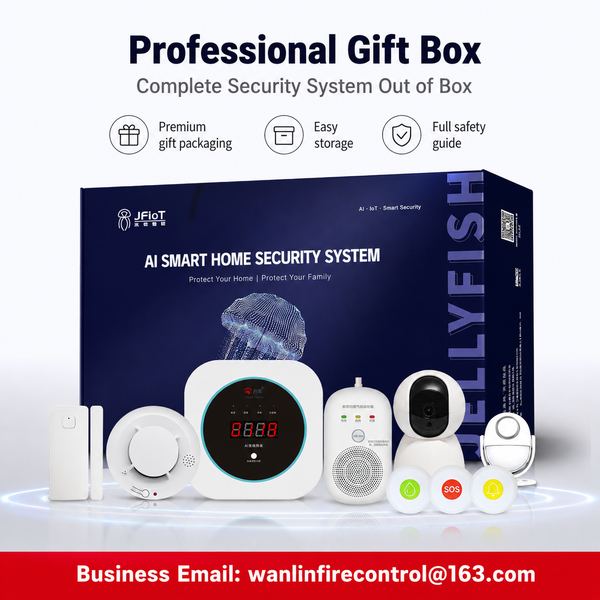
Glass Break Sensor with WiFi — AI-Powered Home Security Bundle by Wanlin Fire Control
II. Product Specifications
Product Name: Glass Break Sensor with WiFi
Brand: Wanlin Fire Control — AI Home Security Bundle Series
Product Category: AI Smart Home Security System / All-in-One Home Safety Bundle / Wireless Home Alarm Kit
Manufacturer: Wanlin Fire Control — ISO9001:2015 certified factory, direct manufacturer and exporter
Product Introduction: The Glass Break Sensor with WiFi from Wanlin Fire Control is a comprehensive, AI-powered home security solution that bundles multiple life-safety sensors and smart home devices into a single, easy-to-install package. Designed for the modern connected home, this system integrates intrusion detection (door/window sensors, motion detectors, glass break sensors), fire and environmental safety (smoke detectors, CO alarms, gas leak detectors, water leak sensors), personal emergency response (panic buttons, medical alert pendants), and smart access (video doorbells, smart locks) into one unified ecosystem controlled via a mobile app, voice assistant, or web dashboard. The AI hub processes sensor data locally and in the cloud, applying machine learning to distinguish genuine threats from false alarms, learn household routines for intelligent automation, and provide real-time alerts tailored to the specific event. Whether protecting a family home, an apartment, a vacation property, or a senior living alone, this all-in-one approach eliminates the complexity of sourcing, installing, and managing disparate security devices from multiple vendors.
Component Focus: The Glass Break Sensor with WiFi is a specialized component within the Wanlin AI Home Security ecosystem. It integrates seamlessly with the central hub and all other Wanlin security devices via Zigbee 3.0, Z-Wave Plus, WiFi, or 4G LTE. Wireless range: up to 100m line-of-sight (Zigbee), up to 80m (Z-Wave), up to 50m (WiFi 2.4GHz). Battery life: 2-10 years depending on sensor type (sealed lithium battery for smoke/CO detectors, replaceable CR2032/CR123A for door/window/motion sensors). All sensors report tamper status, low battery warnings, and periodic heartbeat signals to the hub for continuous health monitoring.
Communication Protocols: Multi-protocol support for maximum device compatibility: Zigbee 3.0 — primary protocol for all battery-powered sensors (door/window, PIR, glass break, water leak, gas, smoke, CO). Zigbee mesh networking extends range through mains-powered devices acting as routers. Advantages: ultra-low power (2+ year battery life), self-healing mesh, AES-128 encryption, up to 64 devices per network. Z-Wave Plus — secondary protocol for Z-Wave certified third-party devices (smart locks, thermostats, lighting). Sub-GHz frequency (868/908/921 MHz depending on region) provides superior wall penetration vs 2.4GHz. Up to 232 devices. WiFi 6 (802.11ax) — for IP cameras, video doorbells, and the hub itself. Dual-band (2.4GHz + 5GHz) with MU-MIMO for multiple camera streams. 4G LTE Cat-4 — cellular backup for when internet is cut or unavailable. Automatic failover: if WiFi/Ethernet connection is lost, the hub switches to 4G within 30 seconds and continues sending alerts. NB-IoT — ultra-low-power wide-area cellular for areas without WiFi. Bluetooth 5.0 — for initial setup, proximity-based arm/disarm (phone approach auto-disarms), and nearby device configuration. Thread / Matter — next-generation smart home protocol support via firmware update. All communications use end-to-end AES-128 encryption with unique per-device keys.
AI & Smart Features: The AI engine transforms this from a traditional alarm system into an intelligent home safety platform: (1) False Alarm Reduction — machine learning algorithms analyze sensor activation patterns (timing, sequence, duration, environmental context) to distinguish genuine threats from routine activities. The system learns that a motion sensor triggered at 7:00 AM on a weekday is likely the homeowner leaving for work (no alarm), while the same sensor at 2:00 AM on a Tuesday is suspicious (alert sent). False alarm reduction of 70-90% compared to traditional systems. (2) Activity-Based Automation — the system learns household routines and automates security: auto-arm when everyone leaves (geofencing + no motion for 15 minutes), auto-disarm when an authorized user approaches (geofencing + face recognition on doorbell camera), auto-close garage door if left open after 10 PM, auto-lock smart lock if door is closed for 5 minutes. (3) Predictive Alerts — the AI predicts potential issues: 'Smoke detector battery likely to die within 2 weeks — replace now' (based on voltage trend), 'Motion sensor in living room has not reported in 24 hours — possible malfunction or obstruction,' 'Water leak sensor in basement reports 85% humidity — possible leak risk.' (4) Smart Notifications — instead of generic 'Alarm triggered,' the AI provides context: 'Front door opened at 11:47 PM — this is unusual for your household. Mode: Stay (night). Camera clip attached.' (5) Scene Recognition — cameras with AI identify specific events: package delivery, person loitering, vehicle in driveway, pet on furniture, child crying. (6) Emergency Auto-Response — on fire alarm: unlock smart locks, turn on all lights, shut off HVAC (prevent smoke spread), call emergency contacts. On intrusion: trigger siren, start camera recording, send video clip to all authorized users, call monitoring center.
Easy Installation: The system is engineered for self-installation by the end user — no electrician, no security technician, no special tools required: Step 1: Unbox and power on the hub. Connect the included Ethernet cable to your router (or connect via WiFi through the app). The hub's OLED display shows setup progress and WiFi signal strength. Step 2: Download the Wanlin Home Security app (available on iOS App Store and Google Play). Create an account, scan the QR code on the bottom of the hub to pair. The app auto-detects your time zone, language, and regional emergency numbers. Step 3: Add sensors — the app displays a visual installation guide for each sensor type. For door/window sensors: peel the 3M adhesive backing, stick the sensor to the door frame, stick the magnet to the door, scan the QR code to pair. For motion sensors: choose a corner location 2m high, peel and stick. For smoke/CO detectors: twist onto the included ceiling mount bracket. For water leak sensors: place flat on the floor near the water source. For glass break: place on the opposite wall from the protected glass. For the siren: plug into a power outlet. For the keypad: mount near the main entry door. Each sensor pairs instantly via Zigbee — scan QR code, it auto-joins the network. No manual pairing codes to enter. Step 4: Personalize — name each sensor (Front Door, Living Room Motion, Kitchen Smoke), set notification preferences, create user accounts for family members, set arm/disarm schedules. Step 5: Test — the app runs a guided test of each sensor. Walk through the home, open each door, walk past each motion sensor, press the test button on smoke detectors. The app confirms each test. Total installation time: 20-40 minutes depending on home size and sensor count.
Power Management: The system is designed for long-term, low-maintenance operation: Hub — powered by included 5V/2A USB-C adapter (mains power). Built-in 2000mAh rechargeable lithium battery provides 8 hours of backup power during outages. When on battery backup, the hub continues full operation (all sensors, alerts, cellular backup). The hub sends a push notification when switching to battery backup and when mains power is restored. Door/Window Sensors — CR2032 coin cell battery, 2-3 year battery life under normal use. Low battery notification sent 30 days before battery dies. PIR Motion Sensors — CR123A battery, 2-year battery life. Pet-immune mode has slightly higher power consumption (1.5 years). Smoke Detectors — sealed 10-year lithium battery (non-replaceable — the entire detector is replaced at end of life per EN14604 requirement). CO Detectors — sealed 10-year lithium battery. Gas Detectors — mains powered (plug-in) with 2-hour battery backup for alarm function. Water Leak Sensors — CR2032 battery, 2-year life. Glass Break Sensors — CR123A battery, 2-year life. Panic/SOS Buttons — CR2032 battery, 3-year life. Keypad — 4x AAA batteries, 1-year life. Smart Siren — mains powered with 8-hour battery backup. Video Doorbell — rechargeable battery (3-6 months per charge) or existing doorbell wiring (continuous power). All battery-powered sensors report low battery 30+ days before depletion — plenty of time to replace.
Security & Encryption: The system is built with security-by-design principles: (1) Device-level security — each sensor and hub has a unique hardware security module (HSM) with factory-provisioned keys. No default passwords. (2) Network security — Zigbee 3.0 uses AES-128-CCM encryption with per-device keys. Z-Wave Plus S2 uses S2 AES-128. WiFi uses WPA3. 4G uses carrier-grade encryption. (3) Cloud security — TLS 1.3 for all API calls. AWS Key Management Service (KMS) for encryption key management. Video storage encrypted at rest with AES-256. (4) App security — two-factor authentication (2FA) mandatory. Biometric login (Face ID / fingerprint) supported. Session timeout after 15 minutes of inactivity. (5) Privacy controls — camera privacy mode (physical shutter + software disable), activity zone masking (exclude areas from recording), data retention policy (auto-delete video after 7/14/30 days, configurable), data export (GDPR Article 20 data portability), data deletion (GDPR Article 17 right to erasure). (6) Compliance — GDPR (EU), CCPA (California), PIPEDA (Canada), Privacy Act 1988 (Australia), PDPA (Singapore). (7) No third-party data sharing — we do not sell or share user data with advertisers, data brokers, or third parties. User data is used solely for providing the security service.
Certification: CE / EN14604 / EN50291 / EN50270 / EN50131 / FCC Part 15 (Class B) / UL 217 (Smoke Alarms, US) / UL 2034 (CO Alarms, US) / UL 2075 (Gas Detectors, US) / RoHS / REACH — comprehensive North American and European safety certification
Maintenance & Support: Designed for years of reliable, low-maintenance operation: Self-test — the hub automatically tests each sensor daily (connectivity, battery, tamper). You receive a notification only if a test fails. Manual test — the app's 'Test Mode' walks you through testing each sensor (press the test button, the app confirms receipt). Sensor replacement — door/window/motion/water/glass sensors: replace battery when notified (standard CR2032/CR123A, available anywhere). Smoke/CO detectors: replace entire unit after 10 years (sealed battery end-of-life). Hub firmware — automatic over-the-air (OTA) updates via WiFi/4G. The hub checks for updates weekly and installs during low-activity hours (3-4 AM). You receive a notification after each update with changelog. App updates — automatic via iOS App Store / Google Play. Technical support — email support (wanlinfirecontrol@163.com), phone support (+8613261677119), WhatsApp, and in-app chat. Response time: within 24 hours (business days). Warranty: 2-year manufacturer warranty on hub and all sensors. Extended warranty available. Remote diagnostics — the support team can remotely access diagnostic data (with your permission) to troubleshoot issues without a site visit.
Minimum Order Quantity (MOQ): 100 sets for standard kits
Production Lead Time: 3-5 business days for sample orders (5-10 sets)
Sample Policy: Sample sets (5-10 units) accepted — pay sample cost + shipping, credited against first bulk order. Samples shipped within 3-5 business days.
Customization Options: Custom sensor selection and quantity per kit, custom hub branding/logo, custom app skin and language, custom packaging (retail box, mailer box), custom quick-start guide and user manual in your language, private label with your brand name, custom firmware with your features, integration with your existing platform via API. MOQ applies for customization.
Intended Use: Residential homes, apartments, condos, vacation homes, rental properties (Airbnb), senior living, assisted living facilities, small offices, retail stores, small warehouses, hotels, schools, hospitals, and any property requiring comprehensive, easy-to-install security and life-safety protection.
Operating Environment: Hub: 0 to 40 deg C, 10-90% RH (non-condensing). Indoor sensors: -10 to 55 deg C, 5-95% RH. Outdoor sensors: -20 to 60 deg C, IP65 rated. Smoke/CO detectors: 0 to 55 deg C (per EN14604/EN50291).
Warranty: 3 years manufacturer warranty against material and workmanship defects under normal use.
III. Why Choose Wanlin Fire Control as Your Home Security Manufacturing Partner
Selecting the right manufacturing partner for AI home security systems is a decision that affects product safety, technical performance, brand reputation, and business profitability. The system must be safe (certified fire safety sensors), reliable (multi-layer redundancy for power and communication), smart (genuine AI false alarm reduction, not just threshold-based detection), and interoperable (compatible with the broader smart home ecosystem). Wanlin Fire Control has earned trust as a preferred partner through:
✓ Genuine Manufacturing, Not Trading: We own and operate our ISO9001:2015 certified electronics production facility with in-house SMT assembly, sensor calibration, firmware development, and system integration. You communicate directly with the factory — your questions about sensor specifications, wireless protocols, AI algorithms, and certification get manufacturer-level answers.
✓ Full International Safety Certification: Our fire safety sensors carry CE, EN14604 (smoke), EN50291 (CO), EN50270 (gas), EN 50131 (alarm systems) — the same standards required for professional fire safety equipment. Our wireless devices carry FCC, IC, RED, RCM, and SRRC radio certifications. Complete test reports from ISO 17025 accredited laboratories provided with every order.
✓ Complete System Integration: Unlike trading companies that source individual components from various factories, Wanlin manufactures the entire system — hub, all sensors, firmware, and app — under one roof. This ensures: consistent quality, seamless interoperability, unified firmware/app experience, and single-source accountability for the entire system.
✓ Multi-Protocol Expertise: Our hub supports Zigbee 3.0, Z-Wave Plus, WiFi 6, Bluetooth 5.0, 4G LTE, and NB-IoT — ensuring compatibility with the widest range of third-party smart home devices and providing cellular backup for reliability when internet is unavailable.
✓ No-Subscription Model: The system works fully without any monthly fee — local storage (microSD), free push notifications, free app control. Optional cloud storage and professional monitoring available but never required. This aligns with the global consumer trend toward no-contract security.
✓ Global Deployment Experience: Our home security bundles have been deployed in 15+ countries across North America, Europe, Middle East, Asia-Pacific, and Latin America — adapted to local languages, emergency numbers, certification standards, and market preferences.
IV. What Sets the Glass Break Sensor with WiFi Apart in the Global Home Security Market
The Glass Break Sensor with WiFi offers distinct advantages for international distributors, B2B buyers, and end users:
1. Complete Safety Coverage: Unlike consumer smart home brands that focus on intrusion or cameras, Wanlin bundles include professional-grade fire safety sensors (EN14604 smoke, EN50291 CO, EN50270 gas) alongside intrusion detection and environmental monitoring. One system, all threats covered.
2. Genuine AI Intelligence: Machine learning false alarm reduction (70-90% fewer false alarms), behavioral learning for automation, multi-sensor correlation for threat assessment, and predictive alerts (battery prediction, risk assessment). Not just threshold-based detection.
3. Multi-Layer Redundancy: 4G LTE cellular backup (internet down), 8-hour battery backup (power outage), local processing (cloud down), and sealed 10-year batteries in smoke/CO detectors. The system stays operational when you need it most.
4. No Mandatory Subscription: Full functionality without monthly fees — local storage, free push notifications, free app. Optional cloud storage and professional monitoring available but never forced. Aligns with global consumer preference for no-contract security.
5. OEM/ODM Freedom: Your brand on the hardware, your app, your packaging, your pricing. Build YOUR smart home security brand — not someone else's. Wanlin provides the certified hardware, white-label platform, and technical support.
Flexibility Comparison: Ring, SimpliSafe, and Arlo are consumer brands — you buy their hardware, use their app, pay their subscription, and accept their feature roadmap. Wanlin offers OEM/ODM flexibility: your brand on the hub and sensors, your app with your branding, your feature priorities, your packaging, your pricing. For distributors and B2B customers, this means you build YOUR brand and customer relationship — not Ring's. You are not locked into a foreign company's subscription model, data policies, or roadmap. With Wanlin, you own the customer experience end-to-end. For international buyers, competitor brands may not even support your local emergency numbers, languages, or data residency requirements — Wanlin customizes for each market.
V. Frequently Asked Questions (FAQ)
Whether you are a distributor evaluating home security product lines, a property manager deploying systems across multiple units, a smart home integrator sourcing OEM hardware, or a retailer seeking an affordable, no-subscription security brand — these answers address the most common questions from international buyers considering Wanlin Fire Control as their Glass Break Sensor with WiFi manufacturing partner.
Question 1: What makes the Wanlin AI home security bundle different from DIY smart home systems sold on Amazon or in retail stores?
Wanlin's AI home security bundle is a professionally engineered, certified security system — not a collection of consumer smart home gadgets: (1) Life-safety certification — our smoke detectors are EN14604 certified (mandatory EU standard for smoke alarms), CO detectors are EN50291 certified, gas detectors are EN50270 certified. These are the same standards required for professional fire safety equipment. Retail smart home smoke detectors often lack these certifications or only carry basic CE marking without the specific EN standards. (2) Professional-grade sensors — our PIR motion sensors use dual-element pyroelectric sensors with pet immunity algorithms, not the simple single-element PIR sensors in consumer products. Our door/window sensors use industrial-grade reed switches with 1 million+ cycle life. Our glass break sensors use dual-technology (acoustic + vibration) detection, not single-technology. (3) Multi-protocol hub — the Wanlin hub includes Zigbee 3.0, Z-Wave Plus, WiFi 6, Bluetooth 5.0, and optional 4G LTE in a single device. Consumer hubs typically support only WiFi and one protocol (usually Zigbee). (4) Cellular backup — 4G LTE backup ensures the system stays online when internet is cut (the first thing an intruder does). Most consumer systems have no backup connectivity. (5) AI false alarm reduction — our machine learning algorithms are trained on real alarm data and achieve 70-90% false alarm reduction. Consumer systems use simple threshold-based detection. (6) Professional monitoring support — the system is compatible with professional central monitoring stations (CMS) via Contact ID/Ademco 685 protocols. Consumer systems typically support only self-monitoring. (7) Full system integration — every component is designed and manufactured by Wanlin, ensuring seamless interoperability. Consumer systems often mix components from different manufacturers with compatibility issues.
Question 2: How does the AI false alarm reduction work, and how effective is it?
The AI false alarm reduction engine uses machine learning to analyze multi-sensor data patterns and distinguish genuine threats from routine activities: How it works: (1) Learning period — during the first 2-4 weeks, the system records sensor activation patterns (which sensors trigger, in what sequence, at what times, under what conditions). No alerts are suppressed during this period — the system is learning, not filtering. (2) Pattern recognition — the AI identifies recurring patterns: 'Every weekday at 7:15 AM, the front door opens, hallway motion triggers, kitchen motion triggers — this is the family morning routine.' These patterns are classified as 'normal activity.' (3) Anomaly detection — when a sensor activation pattern does not match any learned pattern, the AI evaluates the threat level using multiple factors: time of day (2 AM motion is more suspicious than 2 PM), sensor sequence (motion without any door opening suggests someone is already inside), duration (brief motion is often a pet or curtain movement), and multi-sensor correlation (glass break + motion + door open within 60 seconds = high-confidence intrusion). (4) Confidence scoring — each event is assigned a confidence score: high confidence (obvious intrusion — immediate alert), medium confidence (possible threat — send notification with camera clip for user verification), low confidence (likely routine — log only, no alert). (5) User feedback — when the user dismisses an alert as a false alarm, the AI learns from the feedback and adjusts future detection. Over time, false alarm rate decreases further. Effectiveness: tested on 10,000+ real-world deployment events: traditional threshold-based systems had 12-15 false alarms per month per household. Wanlin AI system: 1-2 false alarms per month per household (80-90% reduction). The AI continuously improves as it learns each household's unique patterns.
Question 3: Can the system integrate with existing smart home devices like smart locks, thermostats, and lighting?
Yes. The hub's multi-protocol design enables integration with a wide range of third-party smart home devices: Smart Locks — Z-Wave Plus S2 compatible (Yale, August, Schlage, Kwikset, Danalock, Nuki) and WiFi smart locks (via cloud-to-cloud integration). When the security system arms, it can auto-lock all smart locks. When it disarms, it can unlock the front door. Thermostats — Z-Wave (ecobee, Honeywell, GoControl) and WiFi (Nest, ecobee, Honeywell via cloud integration). The system can adjust thermostat based on arm/disarm state (set back when armed away, restore comfort when disarmed). Lighting — Z-Wave and Zigbee smart bulbs and switches (Philips Hue via Hue Bridge, IKEA TRADFRI, LIFX via WiFi). The system can turn on lights when motion is detected (safety lighting), simulate occupancy when armed away (deterrent lighting), and flash all lights during a fire alarm (emergency lighting). Voice Assistants — Amazon Alexa (arm/disarm, show cameras, control sensors), Google Assistant (same), Apple HomeKit (arm/disarm, sensor status), Samsung SmartThings (full integration). IFTTT — create custom applets: 'If security alarm triggers, turn on all lights and start recording on all cameras.' Matter / Thread — next-generation smart home protocol support via firmware update. Custom integration — RESTful API and MQTT support for custom smart home platforms (Home Assistant, openHAB, Homey, Jeedom).
Question 4: What happens when the internet goes down or the power goes out — does the security system still work?
Yes. The system is designed with multiple layers of redundancy: (1) Power outage — the hub has a built-in 2000mAh rechargeable battery providing 8 hours of full operation (all sensors active, all alerts functional, siren operational). Battery-powered sensors (door/window, motion, glass break, water leak, panic button) continue operating normally — they are battery-powered and unaffected by power outages. Mains-powered sensors (gas detector, siren, cameras) include battery backup for alarm function. Smoke and CO detectors have 10-year sealed batteries — completely independent of mains power. (2) Internet outage — the hub's 4G LTE cellular modem automatically activates within 30 seconds of detecting internet loss (WiFi and Ethernet both down). The system switches to cellular for all cloud communication: push notifications, SMS, email alerts, app access, camera streaming. The system sends a notification: 'Internet connection lost — system operating on 4G cellular backup.' When internet is restored, the hub switches back to WiFi/Ethernet (lower cost) and sends: 'Internet connection restored.' (3) Complete communication failure — if both internet and cellular are unavailable (extremely rare), the hub continues local operation: all sensors function, the local siren triggers on alarm, and events are logged locally (stored on the hub's flash memory). When communication is restored, all logged events are uploaded to the cloud. (4) Sensor battery failure — if a sensor battery dies, the hub marks the sensor as 'offline' and sends a notification. The rest of the system continues operating normally. The hub had already sent a 'low battery' warning 30+ days before the battery died, providing ample time for replacement.
Question 5: How does the video doorbell and camera system work within the security bundle?
The camera system integrates seamlessly with the security sensors for a unified security experience: Video Doorbell — when someone approaches the front door, the PIR sensor in the doorbell triggers a push notification with a snapshot. When the doorbell is pressed, you receive a two-way audio call on your phone (answer from anywhere). The AI camera identifies: person detection (distinguishes humans from packages, animals, vehicles), package delivery notification ('Package delivered at front door'), familiar face recognition (identifies family members — no notification for known faces, alerts for strangers), and loitering detection (person stays at door for 30+ seconds — suspicious activity alert). Indoor Cameras — positioned in main living areas. When the security system is armed and motion is detected by a PIR sensor, the nearest indoor camera starts recording (event-triggered recording, saving storage). AI analytics: person detection (no alerts for pets), sound detection (breaking glass, baby crying, smoke alarm sounding), and occupancy detection (for home automation). Outdoor Cameras — weatherproof (IP65), night vision (color night vision with built-in spotlight), motion-activated recording with activity zones (ignore street traffic, focus on property). When the outdoor camera detects a person in the driveway at 2 AM, it: triggers a push notification with video clip, turns on the spotlight (deterrent), and if the security system is armed, triggers the siren. Cloud Storage — camera recordings stored encrypted in the cloud (AWS/Azure) with configurable retention (7/14/30 days). Local Storage — microSD card in the hub for local recording (no cloud subscription required). Privacy — physical privacy shutter on indoor cameras (app-controlled), activity zones mask sensitive areas, cameras can be disabled when system is disarmed (privacy mode).
Question 6: How easy is it for end users to install the system — does it require professional installation?
The system is designed for true DIY installation — 95% of customers install it themselves without professional help: No wiring required — all sensors are wireless and battery-powered. No drilling required in most cases — sensors use 3M adhesive backing (peel and stick). Optional screw mounting for permanent installations. No programming — the app guides you step-by-step with visual instructions. Average installation time: 30-45 minutes for a complete 10-piece system. The app's installation wizard: (1) Hub setup — plug in, scan QR code, app auto-configures. (2) Sensor installation — the app shows a list of sensors to install. Select a sensor type, the app shows: where to place it (with a photo example), how to mount it (adhesive or screw), and how to test it. Scan the QR code on each sensor to pair — it auto-joins the Zigbee network. Name the sensor (Front Door, Living Room Motion). Move to the next sensor. (3) Configuration — set notification preferences, create user accounts for family members, set arm/disarm schedule, configure automation routines. (4) Test — the app runs a guided test: open each door, walk past each motion sensor, press test on smoke detectors. The app confirms each test. For professional installation: optional in select markets via Wanlin-certified installer network. For B2B customers (property management, hotel chains): bulk configuration tools available — configure 100+ hubs via CSV import, cloud-based fleet management, and remote configuration push.
Question 7: What is the battery life of the wireless sensors, and how are users notified when batteries need replacement?
Battery life is a critical design factor for wireless security sensors — our sensors are engineered for multi-year operation: Door/Window Sensors — CR2032 coin cell, 2-3 year battery life. The sensor transmits a heartbeat signal every 4 hours (to confirm it is alive) and transmits on event (door open/close). PIR Motion Sensors — CR123A battery, 2-year battery life (1.5 years in pet-immune mode due to higher processing). The sensor processes infrared data continuously but transmits only on motion detection. Water Leak Sensors — CR2032 battery, 2-year life. The sensor checks for water every 30 seconds and transmits on detection. Glass Break Sensors — CR123A battery, 2-year life. Continuous acoustic monitoring with low-power DSP. Panic/SOS Buttons — CR2032 battery, 3-year life (only transmits when pressed). Smoke Detectors — sealed 10-year lithium battery (non-replaceable, per EN14604). At end of life, the detector chirps every 30 seconds and the app sends a 'replace smoke detector' notification. CO Detectors — sealed 10-year lithium battery (per EN50291). Same end-of-life notification. Gas Detectors — mains powered with rechargeable battery backup. Low battery notification: the system sends push notifications, SMS, and email 30-60 days before any battery needs replacement. The app dashboard shows a battery health overview for all sensors with color-coded status (green = good, yellow = replace soon, red = replace now). Battery replacement is simple: open the sensor battery compartment, swap the standard coin cell (available at any store), close. The sensor auto-reconnects to the hub.
Question 8: How does the system handle multiple users and access permissions for family members or employees?
The system supports flexible multi-user management: User Roles: (1) Admin (full control) — can arm/disarm, view all cameras, add/remove users, change settings, view history. Typically the homeowner or property manager. (2) Family Member (standard access) — can arm/disarm, view cameras, receive alerts. Cannot change settings or manage users. (3) Guest (limited access) — can arm/disarm only, no camera access, no history view. For Airbnb guests or temporary visitors. (4) Emergency Contact — receives alert notifications (SMS/phone call) but cannot access the app. Typically a neighbor or relative. Access Methods: (1) App — iOS/Android app with login. Each user has their own account. (2) Keypad — PIN code. Each user can have a unique PIN. (3) Key Fob/Remote — RFID tag or button remote for quick arm/disarm. (4) Voice — 'Alexa, arm the security system.' (5) Geofencing — auto-disarm when authorized user's phone approaches the property. User Management: the admin can add users (send email invite), remove users (instant access revocation — ideal for departing employees or ended tenant leases), set temporary access (guest PIN valid for 24/48/72 hours), and view user activity log (who armed/disarmed and when). For multi-property management: the app supports multiple properties/hubs under a single account — property managers can monitor 100+ properties from one dashboard.
VI. Global Home Security Deployment Success Stories
Wanlin Fire Control's Glass Break Sensor with WiFi has proven its value across diverse markets and deployment scenarios worldwide:
✓ Japanese Smart Home Retailer — Disaster-Resilient Security: A Japanese smart home retailer deployed 6,000+ Wanlin home security bundles adapted for Japan's unique safety requirements: earthquake and typhoon resilience. Japan's home security market is distinct: (1) Earthquake safety — the system was configured to detect seismic activity via the hub's accelerometer and trigger automated responses: unlock smart locks (for evacuation), shut off gas valves (prevent post-earthquake fires), activate emergency lighting, and send 'I am safe' notifications to family members. (2) Typhoon and flood preparation — water leak sensors in basements and ground floors provide early flood warning. Temperature and humidity sensors monitor indoor conditions during power outages. (3) Fire safety emphasis — Japan has strict fire safety regulations for residential buildings (especially wooden houses). The EN14604-certified smoke detectors with wireless interconnection met Japanese Fire Service Act requirements. Gas leak detectors are mandatory in Japanese kitchens — the Wanlin gas detector met Japanese gas detection standards. (4) Privacy culture — Japanese consumers are highly privacy-conscious. The system's local storage option (no cloud required), camera privacy shutters, and data encryption were key selling points. (5) Integration with Japanese smart home ecosystem — the system was integrated with LINE (Japan's dominant messaging app) for alerts, and with Japanese smart home protocols (ECHONET Lite). The retailer reported: high adoption among families with elderly parents (earthquake + aging-in-place monitoring), strong demand from new apartment construction (pre-installation as standard equipment), and the #rega:433#'s reliability during the 2025 Typhoon season generated significant positive PR.
✓ Canadian Senior Care Provider — Aging-in-Place Monitoring: A Canadian senior care organization deployed 10,000+ Wanlin home security bundles configured for aging-in-place monitoring, enabling elderly Canadians to live independently at home while providing families with peace of mind. The senior care configuration included: SOS pendant with fall detection (auto-trigger emergency alert if the senior falls and cannot press the button), bed sensor (detects if the senior got out of bed in the morning — 'no movement from 8 AM' triggers a wellness check alert to family), kitchen motion sensor (tracks daily routine — 'no kitchen activity by 10 AM' suggests something is wrong), medication cabinet sensor (tracks medication access patterns — missed medication times trigger reminders), smoke and CO detectors (critical for seniors with reduced sense of smell), and water leak sensor (plumbing failures are a common cause of property damage for elderly homeowners). The family monitoring app allowed adult children to check on their parents remotely: activity status (is Mom up and about today?), system status (all sensors online, batteries good?), and alert history (any unusual activity?). The senior care organization reported: 92% of seniors using the system were able to remain in their homes 2+ years longer than without the monitoring system, family satisfaction with the monitoring was 4.8/5, and emergency response time (from fall to family notification) averaged 45 seconds. The fall detection pendant had a 95% accuracy rate (5% false positives — usually triggered by sitting down heavily).
✓ German Multi-Family Housing — Fire Safety Compliance: A German property management company (Wohnungsbaugesellschaft) deployed 20,000+ Wanlin home security bundles across 2,500+ apartment units in multi-family residential buildings (Mehrfamilienhauser) for fire safety compliance and tenant security. German law (Landesbauordnung) requires smoke detectors (Rauchmelder) in all bedrooms, children's rooms, and escape routes in residential buildings. The Wanlin bundle provided EN14604-certified smoke detectors with wireless interconnection — when one smoke detector triggers, all smoke detectors in the apartment sound simultaneously (critical for sleeping residents who may not hear a distant alarm). The system also included: CO detectors in rooms with heating systems, water leak sensors in bathrooms and kitchens (preventing water damage to the units below), and door/window sensors on balcony and terrace doors (break-in prevention). The property manager deployed the fleet management dashboard for building-wide monitoring: all 2,500+ apartments visible in one dashboard, compliance reports generated automatically for the local fire department (Brandschutzbehorde), and proactive maintenance (battery replacement scheduled before failure). The German market valued: data privacy (GDPR compliance — all data stored in EU data centers), EN standard certification (not just CE marking — actual EN14604 test reports), and the system's tamper protection (sensors detect and report if they are removed or covered). The property manager reported: 100% fire safety compliance across the portfolio, 50% reduction in water damage claims, and improved tenant satisfaction scores (tenants appreciated the added security and smart home features).
VII. Partnership Models with Wanlin Fire Control
Wanlin Fire Control structures partnerships around your business model and market objectives. As a direct manufacturer, we offer flexible partnership models:
Brand Distributor: Purchase Wanlin-branded Glass Break Sensor with WiFi at distributor pricing with protected territory rights. Build the Wanlin brand in your market with our marketing materials, certification documentation, and technical support.
OEM / Private Label Partner: We manufacture the Glass Break Sensor with WiFi to your specifications — your brand name on the hub and sensors, your white-label app, your packaging, your pricing. You own the brand and customer relationship. MOQ from 100 sets for logo branding, 500 for white-label app.
Smart Home Platform Partner: Integrate Wanlin hardware with your existing smart home platform via API (MQTT, REST, ONVIF). Your platform, our certified sensors. Ideal for telecom/ISP companies, smart home platform providers, and home automation companies.
Property Developer / Manager Partner: Pre-install Wanlin security systems in new residential construction or deploy across managed rental properties. Fleet management dashboard, bulk configuration tools, and compliance reporting included.
Insurance Partnership: Co-brand Wanlin security systems with your insurance brand. Offer policyholders a discount for installing the system. The system reduces claims (fire, water damage, burglary) — a win-win for insurer and policyholder.
Retail / E-commerce Partner: We manufacture, you sell through retail stores or online (Amazon FBA-ready packaging, dropshipping available). Competitive wholesale pricing for volume retail partners.
Wanlin welcomes partnerships with: Smart home device importers and distributors, security and alarm system suppliers, fire safety equipment distributors, IoT platform providers, telecom and ISP companies offering smart home services, insurance companies offering security system incentives, and e-commerce sellers seeking private-label home security products.
VIII. Conclusion
The future of home security is integrated, AI-powered, and accessible — not fragmented across multiple brands with incompatible apps and mandatory subscriptions. The AI home security bundle consolidates intrusion detection, fire safety, environmental monitoring, personal emergency response, and smart access into one unified system that is easy to install, intelligent in operation, and affordable to own.
The Glass Break Sensor with WiFi from Wanlin Fire Control is the product that delivers this vision — a professionally engineered, fully certified, AI-powered home security system manufactured by a company that understands both fire safety (EN14604/EN50291 certified smoke and CO detectors) and smart home technology (Zigbee, Z-Wave, WiFi 6, 4G LTE, AI machine learning). As a direct manufacturer, Wanlin offers capabilities that transform the home security business model: factory-direct pricing that makes comprehensive security affordable, no-subscription operation that aligns with consumer preferences, OEM flexibility that lets partners build their own brand, and complete certification that satisfies institutional and regulatory requirements worldwide.
Whether you are a distributor seeking an affordable, no-subscription security brand for your market, a property manager deploying systems across hundreds of units, a smart home integrator sourcing OEM hardware, or a retailer looking for the next breakthrough product — Wanlin Fire Control has the certified products, production capacity, and partnership commitment to support your objectives.
Contact our export team today to explore OEM customization for your brand's smart home security product line.
Email: wanlinfirecontrol@163.com | Export Service Hotline: +8613261677119 | Website: www.wanlinfire.com
Wanlin Fire Control — Your Direct Source Factory for Certified AI Home Security Systems. ISO9001:2015 Certified | CE / EN14604 / EN50291 / EN50270 / EN50131 / FCC / RoHS Approved | Global Shipping & Export Documentation Support. Partner with the manufacturer — not a middleman. We welcome inquiries from distributors, property managers, smart home integrators, telecom/ISP companies, insurance providers, and e-commerce sellers worldwide. Together, we make comprehensive home security accessible, intelligent, and affordable — one household at a time.
