Temperature Sensor for Medical Facility: Professional Temperature Monitoring Solutions by Wanlin Fir
I. Why Heat Detection Is a Critical Component of Fire Safety Systems
Heat detectors are a fundamental layer of fire detection — responding to the thermal energy of a fire rather than visible smoke particles. While smoke detectors excel in living spaces and corridors, heat detectors are the correct and often code-mandated choice for environments where smoke, dust, steam, or fumes would cause excessive false alarms: kitchens, garages, workshops, boiler rooms, attics, laundry rooms, industrial production areas, parking garages, and many other spaces where smoke detectors are impractical.
Heat detectors sense fire through two mechanisms: fixed temperature detection — activating when the temperature at the detector reaches a predetermined threshold (e.g., 54degC for EN 54-5 Class A1, 78degC for Class B), ideal for environments with normal temperature fluctuations; and rate-of-rise detection — activating when the temperature rises faster than a calibrated rate (typically 7.8-8.3degC/min per EN 54-5), providing earlier warning for rapidly developing fires before the absolute temperature reaches dangerous levels. Many models combine both principles for comprehensive protection.
The Temperature Sensor for Medical Facility from Wanlin Fire Control provides reliable, EN 54-5 certified thermal fire detection using precision NTC thermistor sensor technology. As a direct manufacturer with over a decade of fire detection expertise, Wanlin produces heat detectors covering the full EN 54-5 temperature class range (A1 through G, with rate-of-rise variants) — combining certified safety performance with factory-direct pricing that makes code-compliant heat detection accessible for projects worldwide.
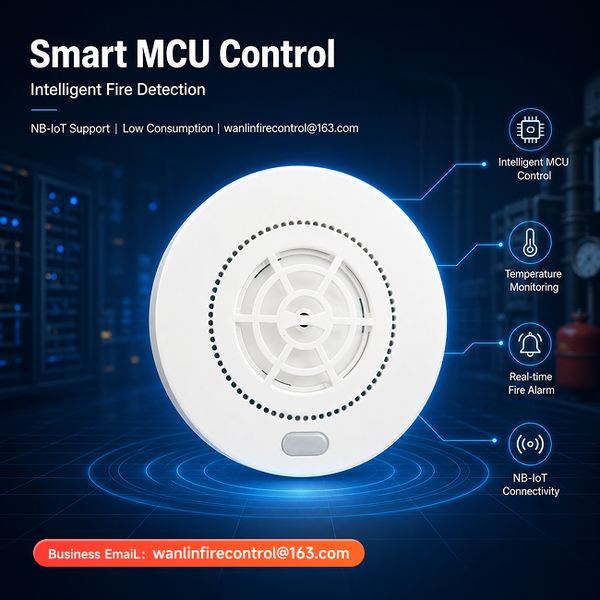
Temperature Sensor for Medical Facility — Certified Heat Detector by Wanlin Fire Control
II. Product Specifications
Product Category: Heat Alarm
Brand: Wanlin Fire Control
Detection Principle: Precision NTC thermistor — provides accurate temperature measurement with fast thermal response
Alarm Class: Fixed temperature 57degC per EN 54-5 Class A2
Response Time: Alarm activation within 20 seconds at rated fixed temperature threshold per EN 54-5
Alarm Temperature: 78degC fixed temperature (EN 54-5 Class A2 rating)
Alarm Notification: Built-in siren (85 dB at 3m) + high-intensity LED indicator (Green=normal, Red=alarm)
Alarm Sound Pressure: ≥95 dB at 3 meters
Visual Indicators: Power LED (green) / Alarm LED (red flashing) / Fault LED (yellow)
Connectivity: Standalone — all alert functions operate independently without any network
SIM / Network: N/A — standalone device (no network required)
Network Independence: Fully independent operation — built-in siren and LED indicator function without any network or external device. No hub, no WiFi, no gateway needed.
Power Supply: Built-in sealed lithium battery (non-replaceable, 10-year life)
Battery Lifetime: 5-7 years under normal operating conditions
Low Battery Warning: Chirp every 60 seconds + LED flash 30 days before battery depletion (network-connected models also send APP/SMS notification)
End-of-Life Warning: Distinctive chirp and LED pattern when sensor reaches end of rated lifetime — typically 10 years from manufacture date. Detector should be replaced when end-of-life signal activates.
Self-Test: Push-button TEST — activates full system check (sensor, siren, LED, battery). Automatic sensor health monitoring every 30 seconds with fault LED indication.
Test/Silence Button: Front-panel button — press to test all alarm functions or silence nuisance alarm (auto-reset after 8 minutes)
Installation: Surface mount via included bracket — screws and wall plugs provided. Twist-lock design for easy detector removal during maintenance and testing.
Mounting Location: Ceiling mount (recommended) — heat rises, so ceiling placement provides earliest detection
Coverage Area: Up to 40-50 sqm for flat ceiling; reduced by 25% for sloped ceilings
Product Dimensions: 105 x 105 x 50 mm / 210g
Enclosure Material: UL94 V-0 flame-retardant ABS + PC blend
Operating Temperature: -10degC to +60degC
Operating Humidity: 10%-93% RH (non-condensing)
Storage Temperature: -20degC to +60degC
IP Rating: IP42 — suitable for indoor and protected outdoor use
Certification: EN 54-5:2017 / CE / RoHS / FCC / UL 521 / REACH
Warranty: 5 years manufacturer warranty against defects
Package Contents: Heat detector unit, mounting base/bracket with twist-lock mechanism, screws and wall plugs, adhesive mounting pad, user manual (multi-language), quick-start guide, warranty card
III. Why Choose Wanlin Fire Control as Your Heat Detector Manufacturing Partner
Selecting the right manufacturing partner for heat detectors is a decision with life-safety implications — product reliability, certification compliance, and consistent thermal response performance are non-negotiable. Wanlin Fire Control has earned trust as a preferred partner for international buyers through:
✓ Genuine Manufacturing, Not Trading: We own and operate our ISO9001:2015 certified production facility with in-house thermal calibration laboratories, SMT assembly lines, injection molding, environmental testing chambers (temperature cycling from -40degC to +150degC, humidity exposure up to 98% RH), thermal response time testing equipment, and automated functional testing stations. You communicate directly with the factory — your technical questions about EN 54-5 class selection, thermal response characteristics, or customization are answered by the engineers who design and build the products.
✓ Full EN 54-5 Class Coverage: Our manufacturing platform produces heat detectors across the complete EN 54-5 temperature class range — A1, A2, B, C, D, E, F, G — plus rate-of-rise (R) variants. Whether you need Class A1 (54degC) for residential kitchens, Class B (69-85degC) for commercial cooking areas, Class C (84-100degC) for industrial processes and parking garages, or Classes D-G for high-temperature applications — Wanlin manufactures them all from one factory.
✓ Multi-Technology Connectivity Portfolio: We manufacture standalone battery-operated detectors, wireless RF interconnected models, WiFi smart detectors, 4G cellular detectors, NB-IoT detectors, LoRaWAN detectors, Zigbee sensors, Z-Wave sensors, and Modbus RTU output models for BMS integration — all from one supplier. You can address every customer segment (residential, commercial, industrial, smart building) without managing multiple supplier relationships.
✓ Partner-First Business Philosophy: We are a manufacturer for distributors, not a fire system brand competing with them. Flexible OEM/ODM with competitive MOQ, white-label mobile APP for smart models, exclusive territory protection, comprehensive marketing support, and dedicated account management. Our success is measured by our partners' market success.
✓ Global Deployment Experience: Our heat detectors protect lives and property in UK social housing kitchens, UAE tower parking garages, German food processing factories, Canadian data centers, Thai hotel kitchens, Nigerian oil & gas facilities, Indonesian government housing, Australian e-commerce brands, Brazilian industrial bakeries, Spanish hospitals, and South African cold storage warehouses.
IV. What Sets the Temperature Sensor for Medical Facility Apart in the Global Market
The Temperature Sensor for Medical Facility offers distinct competitive advantages for international buyers:
1. Precision Thermal Sensing: High-quality NTC thermistors individually calibrated in our temperature chamber laboratory at the detector's rated fixed temperature threshold. Every detector is tested against EN 54-5 response time requirements — not batch-tested, every unit. This individual calibration ensures the detector activates within the precise EN 54-5 time window at its rated temperature — not too early (false alarm risk) and not too late (delayed detection risk).
2. Certified Safety, Factory-Direct Value: EN 54-5 / CE (CPR 305/2011) certification combined with factory-direct pricing creates a value proposition competitors cannot match. Trading companies offer lower cost but uncertain certification and quality. Fire system brands offer certification but with brand premiums and rigid distribution models. Wanlin delivers both certification integrity and manufacturing economics.
3. The Right Detector for Every Environment: Heat detectors are NOT one-size-fits-all — the correct temperature class, connectivity method, and environmental rating depend on the application. Wanlin produces the full spectrum: A1 (54degC) for living areas, A2/B for kitchens and garages, B/C for commercial and industrial, D+ for high-temperature processes, ATEX/IECEx for hazardous areas, IP65+ for wet/dusty environments, and extended temperature range (-30degC to +105degC) for cold storage and high-temperature applications. One supplier covers all your customers' needs.
4. False Alarm Immunity: Unlike smoke detectors that can be triggered by cooking, steam, dust, or vehicle exhaust, heat detectors respond only to temperature — making them inherently false-alarm resistant in challenging environments. Combined with our individual calibration and dual-mode sensing (fixed temperature + rate-of-rise), the Temperature Sensor for Medical Facility provides reliable fire detection without the costly disruptions of false alarms.
5. Regulatory-Ready for Global Markets: Every Wanlin heat detector is designed for certification. The core platform is lab-tested to EN 54-5, and we manage country-specific certification (UL 521, VdS, LPCB, AS 7240.5, ABNT NBR 9441, KC, GOST) on your behalf. When you need market-specific approval, we manage the process with accredited laboratories — not you.
6. 10-Year Replacement Cycle: EN 54-5 and NFPA 72 recommend heat detector replacement after 10 years of service. Every detector sold today generates a guaranteed replacement sale — creating predictable, recurring demand that builds long-term distributor business value.
Why Distributors Choose Wanlin: Apollo, Hochiki, System Sensor, and Siemens are fire system brands that sell through established distribution — they compete with new distributors for territory and margin. Wanlin is a manufacturer: we make EN 54-5 / UL 521 certified heat detectors to international standards, you build the brand and distribution channel in your market. We offer private labeling, OEM branding, country-specific certification management, and partnership models that fire system brands cannot provide. This fundamental difference — manufacturer-partner vs. competing brand — is why international distributors source heat detectors from Wanlin.
V. Frequently Asked Questions (FAQ)
Whether you are evaluating heat detector suppliers, expanding your fire safety product catalog as a distributor, or specifying detection equipment for a building project — these answers address the most common questions from international buyers considering Wanlin Fire Control as their Temperature Sensor for Medical Facility manufacturing partner.
Question 1: How does a heat detector work, and what is the difference between fixed temperature and rate-of-rise detection?
Heat detectors respond to thermal energy from a fire rather than smoke particles — making them ideal for environments where smoke detectors would generate false alarms (dusty, steamy, or smoky environments like kitchens, garages, workshops, and boiler rooms). Two detection principles: Fixed Temperature — the detector contains a thermistor (temperature-sensitive resistor) that continuously measures ambient temperature. When the temperature at the detector reaches the rated fixed temperature threshold (e.g., 54degC for Class A1, 78degC for Class B per EN 54-5), the alarm activates. Best for: environments where rapid temperature increase is expected (kitchens, boiler rooms, industrial processes) — the detector ignores normal temperature fluctuations below the fixed threshold; Rate-of-Rise (ROR) — the detector measures the rate of temperature increase over time. If the temperature rises faster than a calibrated rate (typically 7.8degC - 8.3degC/min per EN 54-5), the alarm activates — even if the absolute temperature is still below a dangerous level. Rate-of-rise detection provides earlier warning for fast-growing fires. Best for: general fire detection where early warning is critical. Many Wanlin heat detectors combine both principles (Class A1R, A2R, BR, etc.) — providing the fast response of rate-of-rise detection with the definitive confirmation of fixed temperature activation. This dual-mode detection is required by many fire codes for general fire detection applications.
Question 2: Where should heat detectors be installed instead of smoke detectors, and what are their advantages in specific environments?
Heat detectors are the correct choice for environments where smoke detectors would cause excessive false alarms: Kitchen areas — cooking smoke, steam, and grease particles trigger photoelectric smoke detectors constantly. Heat detectors (Class A2 or B, 54-78degC) ignore cooking byproducts and alarm only on actual fire temperatures. Garages and workshops — vehicle exhaust, sawdust, welding fumes, and construction dust overwhelm smoke detectors. Heat detectors operate reliably regardless of airborne particles. Boiler rooms, furnace rooms, and mechanical rooms — normal operation produces heat and combustion byproducts that confuse smoke detectors. Heat detectors with appropriate temperature class (B or C, 69-84degC) provide fire detection without nuisance alarms. Attics and unconditioned spaces — dust, insects, temperature extremes, and poor ventilation degrade smoke detector performance. Heat detectors with wide operating temperature range and dust-resistant design are the reliable choice. Laundry rooms — lint and humidity trigger false smoke alarms. Heat detectors ignore both. Industrial processes — welding, grinding, painting, and chemical processes produce particulates and vapors that render smoke detectors unusable. Enclosed parking garages — vehicle exhaust contains particulates that trigger smoke detectors. Heat detectors are standard for parking garage fire detection (often Class C, 84degC). Data centers / server rooms — very early smoke detection (VESDA/HSSD) is preferred, but heat detectors provide reliable backup protection against thermal runaway and fire that smoke systems might miss in high-airflow environments.
Question 3: What do EN 54-5 heat detector classes (A1, A2, B, C, D, E, F, G) mean for product selection?
EN 54-5 classifies point-type heat detectors by their application temperature range — this determines which detector to install in which environment: Class A1 — typical application temperature: 25degC, maximum application temperature: 50degC, static response temperature (alarm threshold): 54degC minimum, 65degC maximum. Most common general-purpose class. Use in: living areas, bedrooms, corridors, offices, retail — environments with normal room temperature. Class A2 — typical app: 25degC, max app: 50degC, alarm: 54-70degC. Similar to A1 with slightly higher upper bound. Class B — typical app: 40degC, max app: 65degC, alarm: 69-85degC. Use in: kitchens (away from direct heat source), boiler rooms, laundry rooms — environments with occasional elevated temperatures. Class C — typical app: 55degC, max app: 80degC, alarm: 84-100degC. Use in: commercial kitchens (near cooking equipment), industrial areas, enclosed parking garages. Class D — typical app: 70degC, max app: 95degC, alarm: 99-115degC. Use in: high-temperature industrial processes, foundries, kiln rooms. Classes E, F, G — for specific high-temperature applications up to 160degC maximum. Rate-of-rise suffix (A1R, A2R, BR, etc.): indicates the detector ALSO responds to rate-of-temperature-rise (typically 7.8-8.3degC/min), providing faster response to rapidly developing fires. Critical note: Always select a heat detector class whose maximum application temperature is ABOVE the highest normal ambient temperature in the installation location. Installing a Class A1 detector (max 50degC) in a boiler room that routinely reaches 55degC will cause false alarms or premature sensor degradation.
Question 4: How do wireless and 4G heat detectors compare to traditional wired detectors in terms of reliability and installation cost?
The shift from wired to wireless/4G heat detectors represents a significant total-cost-of-ownership (TCO) advantage: Wired conventional heat detectors require: fire-rated cable run from each detector to the fire alarm control panel (FACP), conduit or cable tray installation, electrician labor for termination and commissioning, and fire stopping at every wall/floor penetration. Installation cost per detector: typically $50-150 for residential, $100-300+ for commercial/industrial — plus FACP and cabling infrastructure. Wireless/4G heat detectors eliminate: all field wiring between detector and control panel, conduit and cable tray runs, fire stopping at penetrations, and most electrician labor. Installation time: under 5 minutes per detector (mount bracket, attach detector, configure via APP). No specialized fire alarm cabling skills required. Total installed cost: 50-70% lower than wired equivalent. Reliability comparison: Wired — single point of failure (cut cable = lost detector). Wireless — each detector operates independently. 4G cellular — zero dependency on building infrastructure (no WiFi, no power wiring, no control panel). If one detector fails or loses connection, others continue operating. Maintenance: Wired — troubleshooting cable faults requires specialized technicians with cable testers. Wireless — APP displays signal strength, battery status, and last-test timestamp for every detector. Failed unit simply removed and replaced. Industry adoption: EN 54-25 (components using radio links) now fully standardized, adopted across EU. NFPA 72 (USA) permits wireless fire detection. Major insurers (FM Global, VdS, LPCB) approve wireless heat detectors for insured properties.
Question 5: Can heat detectors integrate with existing fire alarm systems, building management systems, and smart home platforms?
Wanlin heat detectors support multiple integration pathways: Fire alarm control panel (FACP) integration — conventional: NC/NO dry contact relay output (available on select models) for direct wiring to FACP zone input. Addressable loop: RS-485 / Modbus RTU output with published register map for integration with third-party addressable FACP systems; Building management system (BMS) — Modbus RTU (RS-485): industry-standard protocol, compatible with Siemens Desigo, Honeywell EBI, Johnson Controls Metasys, Schneider EcoStruxure; BACnet gateway: optional add-on converting Modbus data to BACnet objects for native BMS integration; MQTT / REST API: cloud-to-cloud integration for custom monitoring platforms and IoT dashboards; Smart home ecosystems — Amazon Alexa: voice query 'Alexa, what is the temperature in the garage?' and smart home routines; Google Home / Google Assistant: voice queries and home automation routines; Apple HomeKit: Siri control and Home app management (HomeKit-certified models available); IFTTT: custom applets connecting heat events to other devices; Standalone operation — all detectors function as complete standalone alarms even without external system integration. The built-in siren, LED, and (for wireless models) APP notification provide full fire detection capability with zero external dependencies. This flexibility means the same heat detector platform can serve: standalone residential installations, commercial fire alarm systems, industrial BMS integration, IoT monitoring platforms, and smart home ecosystems.
Question 6: What maintenance do heat detectors require over their lifespan compared to smoke detectors?
Heat detectors generally require LESS maintenance than smoke detectors because they have no optical chamber that accumulates dust, no radioactive source that decays, and no smoke entry ports that can become clogged. However, regular testing is still essential: Monthly — press the TEST button on each detector. The unit should sound the full alarm (siren + LED). For interconnected or networked systems, verify all linked detectors respond. If the unit does not sound, replace batteries (battery models) or replace the unit (sealed models); Quarterly — visually inspect each detector. Check for: physical damage or discoloration (heat exposure indicator), paint overspray or coating on the detector (paint insulates the thermistor and delays temperature response — PAINTED HEAT DETECTORS MUST BE REPLACED!), accumulation of debris or dust on the sensing element, and obstruction by stored items, decorations, or ceiling modifications; Annual — professional functional test: use a controlled heat source (authorized heat detector tester — NOT an open flame, hair dryer, or heat gun which can damage the thermistor) to raise the detector temperature above its activation threshold. Verify alarm activation within EN 54-5 specified time window, and verify remote notification (APP, SMS, building management system) for connected models. For rate-of-rise detectors, verify rate-of-rise response; Every 10 years — replace the detector. EN 54-5 and NFPA 72 recommend replacement of heat detectors after 10 years of service (or earlier if end-of-life signal activates). Sensor degradation over time can shift the activation temperature. Note: Unlike smoke detectors, heat detectors don't require chamber cleaning, sensitivity testing with smoke aerosol, or replacement of radioactive sources — making them lower-maintenance for commercial and industrial deployments.
Question 7: What is the difference between a heat detector and a temperature sensor — can I use one product for both fire detection and temperature monitoring?
Heat detectors and temperature sensors serve different but complementary functions: Heat detectors are life-safety devices — their sole purpose is detecting fire by sensing temperature at or above a fixed threshold (with optional rate-of-rise). They are certified to EN 54-5, UL 521, or equivalent fire detection standards. They output a binary alarm signal (fire / no fire) and include mandatory features: EN 54-5 certified, built-in siren or alarm output, supervision (fault detection), tamper resistance, and they cannot be silenced for maintenance without manual intervention. Temperature sensors are monitoring/control devices — they continuously measure and report temperature for environmental monitoring, process control, or building automation. They output an analog or digital temperature reading (degrees C/F) and include optional alarm thresholds. They are typically certified to EMC/safety standards (CE, FCC) but not fire detection standards. Wanlin addresses both needs: our IoT Temperature Sensor (monitoring) provides continuous temperature data with user-configurable alarm thresholds, data logging, and cloud platform dashboard — ideal for cold chain monitoring, server room environmental monitoring, greenhouse climate control. Our EN 54-5 Heat Detector (fire detection) provides certified fire detection with built-in siren — required by building code for fire protection. For applications requiring BOTH (e.g., smart buildings): install EN 54-5 certified heat detectors for code-compliant fire detection + IoT temperature sensors for environmental monitoring. They serve different purposes with different certifications — mixing them can create compliance gaps.
Question 8: Can a single heat detector model be used across different countries, or do I need different models for different markets?
Heat detector certification is country-specific to a degree — but the core EN 54-5 standard provides a harmonized European baseline recognized across EU/EEA, UK, and many non-EU markets. European Union — CE marked per CPR 305/2011, EN 54-5:2017+A1:2018 certified, DoP (Declaration of Performance) provided. Our standard EU model covers all 27 member states with multi-language documentation (24 EU languages). United Kingdom — UKCA marked, BS EN 54-5:2017 certified (post-Brexit), with UK-specific DoP. We manage UKCA conversion for existing CE-marked products. North America — UL 521 listed / FM Approved for USA and Canada (ULC-S529). Different testing protocols than EN 54-5 but similar performance criteria. We offer UL/FM certified variants with appropriate markings and English/Spanish/French manuals. Australia/New Zealand — AS 7240.5 certified (harmonized with ISO 7240-5), RCM marked. Middle East — Civil Defence approval often requires EN 54-5 certification recognized by local authority. SASO (Saudi Arabia), ESMA (UAE), and QCDD (Qatar) typically accept EN 54-5 with additional local marking requirements. Asia Pacific — varies significantly. Some markets accept EN 54-5 (Vietnam, Philippines, Indonesia), others require local certification (KC for Korea, CCCF for China). Wanlin manages the certification process on your behalf — whether under Wanlin brand or OEM brand.
VI. Global Client Success Stories
Wanlin Fire Control's Temperature Sensor for Medical Facility has proven its life-saving value across diverse deployment scenarios worldwide:
✓ Social Housing Kitchen Safety — United Kingdom: A UK housing association managing 22,000+ social housing units deployed Wanlin's EN 54-5 certified heat detectors in all kitchen areas to meet fire safety requirements under UK Building Regulations Approved Document B. The regulation requires heat detectors (not smoke detectors) in kitchens to prevent cooking-related false alarms. Each property received: 1x Wanlin battery-operated heat detector (Class A2, 54degC) mounted on the kitchen ceiling at least 0.3m from walls and light fixtures. The 10-year sealed lithium battery model was chosen to eliminate ongoing tenant battery replacement. Over 25,000 detectors deployed. The housing association reports: zero cooking-related false fire alarms (vs. 400+ per year with previous smoke detectors), 100% kitchen fire detection compliance verified during annual inspections, detection of 3 actual kitchen fires (chip pan, toaster, unattended cooking) in the first 18 months with early alarm enabling rapid resident response, and zero battery-related service call-outs, dramatically reducing maintenance costs.
✓ E-commerce Brand Launch — Australia: An Australian fire safety e-commerce brand launched a private-label heat detector product line manufactured entirely by Wanlin. The brand owner identified an underserved market segment: Australian homeowners who need kitchen and garage heat detectors but can only find smoke detectors at retail. Wanlin provided full OEM service: custom-branded heat detectors with Australian-appropriate design (matte white, compact profile), AS 7240.5 certification (harmonized with EN 54-5 for the Australian market), RCM electromagnetic compatibility marking, Australian English voice alerts for smart WiFi models, custom retail packaging (designed for Bunnings/Mitre 10 shelf and Amazon AU), Amazon FBA preparation, and comprehensive installation and placement videos filmed in Australian homes. The product launched with 3 SKUs: Basic battery-operated (AUD $29.99), digital display with peak memory (AUD $44.99), and WiFi smart with APP (AUD $59.99). Within 12 months: #1 Best Seller in Heat Detectors on Amazon AU, 4.6-star average from 320+ reviews, expanded product line to include smoke detectors, CO detectors, and combination units, and AUD $1.2M annual revenue from the fire detection category. The brand owner specifically credited Wanlin's ability to manage the AS 7240.5 certification process through an Australian accredited laboratory as the make-or-break factor in their launch timeline.
✓ Government Housing Program — Indonesia: Indonesia's Ministry of Public Works and Housing included Wanlin heat detectors in a national fire safety program targeting 15,000 low-income housing units (Rusunawa public housing towers) across Jakarta, Surabaya, and Medan. The program addresses Indonesia's primary kitchen fire risk: LPG cooking (97% of Indonesian households use LPG) in small, often poorly ventilated apartment kitchens. Each unit received: 1x battery-operated heat detector (Class A2, 54degC) installed in the kitchen area, 10-year sealed battery (zero maintenance — critical for low-income residents who cannot afford battery replacement), and Bahasa Indonesia quick-start guide with pictogram instructions (for residents with limited literacy). After 18 months: 94% detector retention rate (detectors remained installed and functional in kitchens), detection of 28 unattended cooking fires — all contained to the cooking area before spreading to the apartment, zero fire-related fatalities in equipped buildings (vs. 3 in non-equipped comparison buildings), and 89% resident satisfaction rating. The Ministry has recommended expanding the program to all 350,000+ existing Rusunawa units and mandating heat detectors in all new public housing construction.
VII. Partnership Models with Wanlin Fire Control
Wanlin Fire Control structures partnerships around your business model. As a direct manufacturer with full in-house production and R&D, we offer flexible partnership models:
Brand Distributor: Purchase Wanlin-branded Temperature Sensor for Medical Facility at distributor pricing → build the Wanlin brand in your territory → we provide marketing materials, technical training, and protected territory rights.
OEM / Private Label Partner: We manufacture the Temperature Sensor for Medical Facility to your specifications — your brand, your packaging, your firmware language/voice alerts — you own the customer relationship and channel. MOQ from 1000 units.
Project / Tender Partner: Joint bidding on government, commercial, or industrial fire safety projects. We provide technical proposals, EN 54-5 certification documentation, reference projects, and competitive bulk pricing for large-scale deployments.
Technology / Assembly Partner: For markets requiring local content — we supply sensor modules, PCBs, and components for local assembly, meeting import substitution requirements while maintaining quality.
E-commerce / FBA Partner: We manufacture, you sell online — full Amazon FBA prep, dropshipping, and direct-to-consumer fulfillment supported. White-label options available.
We are actively seeking: Regional exclusive distributors for heat detectors and temperature sensors, fire safety product wholesalers, property developer specification partners, MEP contractor and fire system integrator partners, data center facility management companies, industrial safety equipment distributors, and government/NGO procurement partners for community fire safety initiatives.
VIII. Conclusion
Heat detection is a critical and non-negotiable component of comprehensive fire safety — required by fire codes worldwide for kitchens, garages, boiler rooms, parking structures, industrial processes, and any environment where smoke detectors would generate unacceptable false alarm rates. The global heat detector market is experiencing strong, diversified growth driven by tightening fire codes, data center construction, industrial safety modernization, smart building adoption, and the ongoing replacement of aging detector fleets.
The Temperature Sensor for Medical Facility from Wanlin Fire Control represents a strategic product opportunity for businesses participating in the global fire safety market. As a direct manufacturer, Wanlin offers capabilities that neither trading companies nor fire system brands can match: factory-direct pricing with full EN 54-5 certification across all temperature classes, the complete technology spectrum (from standalone battery-operated through 4G cellular to ATEX-certified) from one supplier, flexible OEM/ODM with white-label options, and a partnership model built on shared market success rather than channel competition.
Whether you are launching a heat detector product line, expanding an existing fire safety catalog, sourcing detection equipment for a code-compliance program, or exploring private-label manufacturing — Wanlin Fire Control has the certified products, production capacity, and partnership commitment to support your business objectives.
Contact our export team today to discuss your fire detection project — residential, commercial, industrial, or data center deployment.
Email: wanlinfirecontrol@163.com | Export Service Hotline: +8613261677119 | Website: www.wanlinfire.com
Wanlin Fire Control — Your Direct Source Factory for Certified Heat Detectors. ISO9001:2015 Certified | EN 54-5:2017 / CE (CPR 305/2011) / FCC / RoHS Approved | Global Shipping & Export Documentation Support. Partner with the manufacturer — not a middleman. We welcome inquiries from distributors, importers, OEM partners, MEP contractors, government procurement, and project buyers worldwide.
